

The most important sound in English almost no one has ever heard of
I have been working with non-native English professionals for more than 15 years. Aside from my writing students, almost every single one of them has shared the same goal: to speak more clearly, more confidently, and with greater ease. There is nothing wrong with that, of course! If you are reading this, you probably want the exact same thing. Here is what I always tell my students, though: before I can teach you how to "speak" better, I really need to teach you how to "hear" better. Because here is —you cannot pronounce a sound well if you cannot hear it in the first place, can you?
There are four main parts of English pronunciation that you need to be aware of, and each one makes a big difference in how clearly you express yourself. We have already covered three of them in other articles: word stress, sentence stress, and linking. Today, we are going to zoom in on the fourth must-know aspect: the schwa sound.
"Schwa? The what?" Almost everyone reacts this way the first time they hear the word. It is a strange name, but the story behind it is simple. In Hebrew, shva (שְׁוָא) is the name of a tiny mark that shows a very short vowel. Later, German borrowed the word in the 19th century for the short, relaxed vowel in their own language and spelled it Schwa. English has that exact same sound, so we use the same name: schwa.
The schwa is the short, relaxed "uh" you hear at the start of about and at the end of sofa. In dictionaries, it is written with the symbol ə (International Phonetic Alphabet), an e. The schwa might be in any syllable that is not the stressed (dominant or strong) one. We call those syllables unstressed, non-stressed, or weak. The schwa is literally the single most common vowel sound we use in English. Yet most native speakers have no idea it even exists, learners find it totally confusing, and it is breaking the of some of the most expensive AI speech recognition tools on the planet. Little sound, .
Surprisingly, native and non-native speakers struggle with this sound in completely different ways. Chances are, nobody ever taught you that it existed, how to use it, or why it matters at all. That is why, although you may know many words in writing, you often cannot recognize them clearly in a fast sentence. The good news is, it is never too late to learn—to take back control of this tiny sound, and in so doing, take both your spoken English and your career to the next level.
Native and non-native speakers: same sound, different problem
For native speakers: a spelling problem
For native speakers, it is , since it comes out perfectly every time they open their mouths. Spelling words containing schwa sounds is where their problem really is. For example, about, sofa, pencil, wagon, and circus all have the same schwa sound, but each one is spelled with a different vowel. .
| Letter | Words with schwa vowels |
|---|---|
| A | about, sofa |
| E | travel |
| I | pencil, family |
| O | wagon, control |
| U | circus, suggest |
For learners: a hearing problem
For non-native learners, it is a challenging pronunciation problem, and it starts with being able to hear that vowel sound in the first place. Native speakers may not understand you well when you speak the words in the way they are spelled instead of in the way they truly sound when spoken out loud.
Not every unstressed vowel is a schwa
What makes it even more complicated is that not every unstressed vowel sounds like a schwa. It would be so much simpler if it did, but it does not. Some vowel sounds keep most of their original sound even in an unstressed position. They are slightly reduced, but not all the way to a schwa. Here are a few examples.
| Vowel sound | Examples |
|---|---|
| long "ee" | city, baby |
| long "oh" | elbow, follow |
| long "you" | argue, value |
| short "i" | building, dentist |
Researchers who studied more than 4,500 words in British English dictionaries found that whether an unstressed vowel turns into a schwa depends on several things, such as where the vowel is in the word, how the syllable is built, and how often the word is used (Dabouis & Fournier, 2025).
Why nobody told you, and why it matters
The experts don't agree
Here is the first reason nobody told you: the experts do not agree on how pronunciation should be taught. For a long time, the ideal was to sound like a native speaker, and the schwa was seen as a mark of "proper" English. Then the goal changed. Teachers started to say that being understood matters more than sounding like a native speaker and teachers were right, weren't they? , one well-known model, the Lingua Franca Core (Jenkins, 2000), looked at what speakers need to know to understand each other in international English. It was huge progress, but with the good intention of making things more simple and relevant for non-native speakers, it left vowel reduction (the schwa) out and it was a mistake.
Others follow the principle (Levis, 2018): teach what really helps listeners understand you. That definitely makes a lot of sense. The only thing is that it never says a word about the schwa and as to what makes intelligibility work. Both sides agree that understanding comes first. One side left the schwa out and the other never mentioned it. Bye bye schwa. But the schwa remained the most commonly heard and voiced sound in English just the same, right?
Teachers and native speakers don't always know best
Logically, you might think that, in any case, in the classroom teachers knew best, right? Well, not always... Often, just like you, they don't know. As the experts do not even agree, many teachers simply decided to skip the schwa. And there is a second reason: some non-native teachers do not even know how to use it themselves. In one study, 60 English teachers in Ilam, Iran, with degrees from a bachelor's to a PhD, largely did not reduce their vowels where English requires it (Gowhary et al., 2016). Of course, you cannot teach a habit you do not have. It is one small study in one city, but it shows how the schwa can , even in the hands of teachers who know English very well.
Native-speaking teachers have the opposite problem. They use the schwa all day long, perfectly, but they are not aware of it. Just like most native speakers, they have no idea it exists, and it is very hard to teach something that is invisible to you. , do they?
What the research says
So who is right? Let's look at what the evidence says. The answer is clear: the schwa matters, and a lot. In 2021, two researchers played words with the wrong stress to 69 university students, native and non-native speakers (Ghosh & Levis, 2021). Here is what they found. When the stress was on the wrong syllable but the vowels stayed the same, listeners usually still recognized the word. Say HO-tel instead of ho-TEL, and people still hear hotel. But when a vowel changed, listeners got lost. Say doc-TOR instead of DOC-tuh, and the schwa turns into a full "or" sound. Now the word is much harder to recognize. So the wrong stress was not the real problem. Pronouncing the vowel wrong was.
AI apps and accent software: more illusion than solution
So what about the new AI technology with all its ? Surely an app like that can fix the little schwa problem, right? Not so fast. Most pronunciation apps analyze what you say into phonemes, single sounds taken one by one, and score each isolated sound against a fixed model of how it should sound. But the schwa is a sound. It is short and quiet, and it changes its color a little with the sounds around it. On its own, taken out of the word, it is very hard to measure. How do you score a chameleon? So an app may give you a good score for a word that a real person would still have trouble understanding.
AI voice assistants have a similar problem: they are built to understand you even when your pronunciation is off, so they will rarely tell you that a schwa is missing or that any other aspect of your pronunciation is lacking. Not surprisingly, some companies have completely stopped trying to teach English to their non-native employees. A company called Sanas sells software that changes a call-centre agent's accent live, during the call. It raised 65 million dollars in 2025 to do just that. The agent, often in the Philippines or India, speaks with their own accent, and the customer hears a smoother, more "standard" one, with the same voice and the same emotion. Another company called Krisp changes the customer's accent instead: since 2026, it changes the caller's accent before it reaches the agent. Smart in a way, maybe, but nobody learns anything in that way, do they?
Worse, why would an employer pay for pronunciation training when a piece of software can hide the accent instead? Language training is expensive. And when a trained employee leaves the company, their newly-acquired language expertise also leaves with them, and the employer's investment is lost. With software, the company pays minute by minute, only for the time it is used. The company can now safely stop investing in language training and put its money into software instead. That is the new model. So if you happen to work for one of these companies and need English to further your career, you are on your own, and will have to pay for your ESL business English training . The good news? What you invest in yourself, no company and no software can ever take away from you.
It cuts both ways
Now, back to the study on wrong stress and wrong vowels. Interestingly enough, its results were true for native and non-native listeners alike. In addition, it works both ways: when you do not hear the schwa in the words, you often do not understand what is being said, and when you do not pronounce the schwa right, your listeners often do not understand you. All this to say that learning how to hear and use the schwa sound is strongly needed in order to better understand and be understood. The experts can keep debating, but what helps you understand others, and helps them understand you, is what you should practice. And as the English put it since the 14th century: . So simple really.
The fix
Start with your ears
OK, enough theory. Now that you understand the problem better, you want to hear about the solution, don't you? Well, as I explained at the beginning of this article, you cannot say a sound well if you cannot hear it in the first place. So start with your ears, not your mouth.
Here is a simple tip. Go to Google and type the word "define," followed by a word to see if it contains schwa sounds. For example, "define about," or "define sofa." The word "define" is the "secret" word: without it, you will not get this box. Now look at the line just under the word. Those are the phonetic symbols. You do not need to understand them all. You just need to understand the stress mark ( ˈ ) that comes before the stressed syllable. Then look for the little upside-down e (ə). That is your schwa!
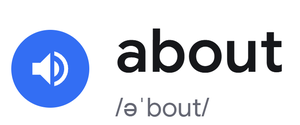
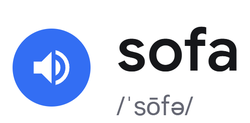
In about, it comes at the beginning. In sofa, it comes at the end. Now click on the little speaker (not on this page, on Google) and listen. Click again, and again. Notice how short and quiet the schwa is. Once you can hear it, try saying it out loud, again and again. A few words a day is enough. Little by little, your ear will catch the schwa everywhere, and it will show in the way you speak too. .
From words to sentences
Now let's move from single words to real sentences. This is where the schwa really hides: in the small secondary words also called function or linking words. Words like to, of, for, a and can. And in little , like would have and going to. In a sentence, we stress the words that carry the message, and we say the small ones quickly and quietly. And what does a quick, quiet vowel often turn into? A schwa.
Listen: "a cup of tea" sounds like "a cup-uh tea". "I can swim" sounds like "I kuhn swim". "Would have" becomes "would-uv", and "going to" becomes "gonna". So two things work together: word stress (the music inside the word) tells you where the schwa is inside a word, and sentence stress (the music inside the sentence) tells you which small words in a sentence will have one.
| Written | Sentence | What you hear |
|---|---|---|
| to | I need to go. | I need tuh go. |
| of | A cup of tea, please. | A cup-uh tea, please. |
| for | Wait for me. | Wait fer me. |
| a | I need a pen. | I need uh pen. |
| can | I can swim. | I kuhn swim. |
| would have | I'd have called. | I'd-uv called. |
| going to | I'm going to call. | I'm gonna call. |
But here is the important part. When you are in a conversation, it is not the time to work on the schwa or on any other aspect of your pronunciation. It is the time to focus on the meaning. Focusing on form is something you should do outside of a conversation, at home, when you do not have to get the meaning and give a sensible answer. So take a sentence you already understand, listen to it again, and this time listen only for where the schwa falls, that is, in both the important (content) words and in the secondary small words.
Once you start hearing it, . That is the moment English stops hiding from your ears. You will start catching many of the words you used to miss, and native speakers will start catching yours as well. And yes, the more you hear, the more you hear, and the more you hear.
Listen to many voices
Now, who should you listen to? One teacher, one podcast, one favorite YouTuber? It is common knowledge that the person that ESL learners understand the best is their teacher. It is a good start, but it is not enough. If you always listen to the same few voices, your ears get used to these voices. Then you meet a new colleague or client, and the schwa seems to disappear again.
Researchers looked at 79 studies on this kind of listening training, where learners hear the same sounds spoken by many different people. The results were clear: learners got much better at hearing the sounds, and the biggest gains were with vowels. But there was a catch. When they heard new words from voices they did not know, they did less well. Part of what they learned stayed attached to the voices they had trained with (Uchihara et al., 2025). Yes!
So mix it up. Listen to men and women, young and older speakers, fast talkers and slow ones, and people from different countries speaking in a variety of accents. The schwa sounds a little different in every mouth. The more voices you hear it in, the more easily you will recognize it in the next one. One voice teaches you the sound. Many voices teach you the language.
Don't trust the spelling
Here is a trap many learners fall into, often without knowing it. They read new words out loud the way they are written. They see "provide" and say "PRO-VIDE," with both syllables equally strong and a full, clear "o," instead of "pruh-VIDE," with a weak first syllable (schwa) followed by a strong one. The first time, it is just a small mistake. But every time you say it again, the wrong sound gets a little deeper into your brain. Say it often enough, and it moves into your long-term memory. Now you have just formed a new unwanted habit. Not exactly what you wanted, is it?
A bad habit is built in the very same way as a good one: through repetition. Your brain does not know the difference between the good, the bad, and the ugly. It simply keeps in memory what you repeat. And once a wrong sound is stored in your long-term memory, it is much harder to fix than it was to learn. So before you say a new word out loud, listen to it first. Look it up, press the little speaker button if any, and hear where the stress and the schwa fall. Then repeat the right sound and pattern, not the wrong ones. Just google it, the same way as with "about" and "sofa" above. You can see where the schwa is, click on the little blue speaker, hear it, and repeat the correct model. Five seconds of listening now can save you months of unlearning later. Ears first, mouth second.
Keep it short and lazy
Beware of one last trap. Do not try to say the schwa "perfectly," that is, slowly and carefully: "a-a-a-bout." The schwa is not a sound you work hard on. In fact, it is the laziest sound in the world. Your jaw drops a little, your lips relax, your tongue rests in the middle of your mouth, and out comes a short, quick "uh." That's it. No effort, no muscles, no drama.
And here is the thing: in English, lazy wins. Minimum effort, maximum result. That is a principle of economy, and it is exactly why the schwa is everywhere. Why spend energy on a syllable that carries no stress when you can save it for the one that does? So keep it short, keep it soft, and move on. If you make the schwa long, it stops being a weak syllable and the word loses its rhythm. For once, being lazy is not a weakness. It is the skill.
Conclusion
So let's put it all together. The schwa is the short, lazy "uh" that hides in almost every unstressed syllable, in place of any vowel sound. Native speakers use it effortlessly all day long without even knowing it exists. For you, though, missing this tiny sound creates two problems. First, it makes it hard to recognize words in fast speech—even words you already know well in writing. Second, it makes it harder for others to understand you when you pronounce words the way they are spelled. And because nobody ever explained this to you, simply goes on, at times creating unwanted consequences.
Remember the question at the top: you know the words, so why can't you hear them, and why can't they hear you? Now you know better, don't you? And the path forward is clear. It takes time and practice, so take it step by step. Put your ears first and your mouth second. Listen for the schwa in content words, small linking words and chunks. Train your ears on many different voices, not just one. Check how a new word sounds instead of trusting its spelling. And when you say the schwa, keep it short, soft, and lazy. It may be the smallest, laziest sound in English. Yet it is the tiny key that unlocks the real language—both in everyday life and at work. Agreed (/əˈɡriːd/)?