

The Beat That Didn't Land
You're on a call with a colleague. You say: "We can't approve that budget." Flat. No word stands out. She hangs up, and in her note to the team she writes that the budget is dead.
What just happened here? What you meant was "We can't approve THAT budget"—this one, not the other one still on the table. One word was supposed to carry a beat, and it didn't. One stressed word, a whole different message and result. The question is: do you want to be the speaker who gets misunderstood, or the one who gets heard?
As we saw in the article on word stress, English has its own music and this music has a double melody. The first melody is inside the word—one syllable , and that's word stress. The second melody is inside the sentence—one word dominates, and that's sentence (phrasal) stress. The budget approval sentence is a disastrous example of the second melody being out of tune.
What makes this particularly hard for a non-native professional is that the two melodies overlap. The word that carries the beat in the sentence is also carrying its own word stress inside itself. So it's not one new rule stacked on top of the last one—it's two rules happening at once, in the same word, at the same time. It's two dances, danced with the same pair of feet.
Getting better at that dance comes down to two skills, built slowly over time: hearing on what word the beat falls in a sentence, and learning where to place that beat yourself. Together, these two skills will help make you better understood—and, just as important, better able to follow English spoken fast.
Three Kinds of Words, One Beat
Content words. In every English sentence, some words are stressed (said louder, longer, and with a higher pitch) and carry the beat, and some don't. The words that usually get the beat are also the ones that carry the meaning: nouns, verbs, adjectives, adverbs, question words like 'where' and 'when,' negative contractions like 'can't' and 'won't,' and possessive pronouns like 'mine' and 'hers.' Take the sentence "He NEEDS to SIGN the DEAL." Which words matter more here—needs, sign, deal, or he, to, the? The answer is obvious. And that's the whole logic of sentence stress: when you speak, which words do you give more weight to—or in other words, which words do you stress? The important ones, of course. So, here's the thing. In English, we stress what matters more, and give less importance to the secondary words. For example, pull out only the content words of our previous sentence—NEEDS, SIGN, DEAL—and you can see that the meaning is already there. Anyone who hears just those three words gets the idea immediately.
Function words (linking words). They do the opposite job. They include articles, prepositions, personal pronouns, possessive adjectives, demonstratives, relative pronouns, conjunctions, and a handful of auxiliary verbs (be, have, do, can, will, and so on). They simply provide the grammatical glue that connects the words in the sentence together—they carry little or no meaning of their own, so they're usually unstressed. Take the same sentence again: "He NEEDS to SIGN the DEAL," but keep only the function words this time: "he... to... the." Say it once, say it a hundred times, louder each time—the listener still has no idea what you mean. Function words are . They make the sentence run smoothly—but oil alone will never get you anywhere.
The focus word. Think of it as the star word—the one that matters most while it's under the spotlight. The spotlight, as a general rule, doesn't stay in one place: move it to another word, and you change the meaning of the whole sentence. And keep in mind that any word—content or function—can become the focus word. Take this sentence: "We didn't approve the new budget yet."
| Sentence (stress shown in bold) | Meaning |
|---|---|
| 1. We didn't approve the new budget yet. | — It wasn't us (perhaps another team or department did it). |
| 2. We didn't approve the new budget yet. | — Someone thinks we approved it. We are saying no, we didn't. |
| 3. We didn't approve the new budget yet. | — We received or reviewed it, but we haven't given approval. |
| 4. We didn't approve the new budget yet. | — We approved an older version, but not this new one. |
| 5. We didn't approve the new budget yet. | — We approved a different document or plan (like the timeline), but not the budget. |
| 6. We didn't approve the new budget yet. | — We haven't done it up to this moment, but we plan to soon. |
Same words, same order, six different messages—and only one of them is the one you meant to send. And most of the time, nobody stops to check which one landed. Welcome to sentence stress in English!
How Your First Language Works Against You
French: French speakers often struggle here because French rhythm works differently. French is syllable-timed: each syllable tends to get roughly equal weight, like soldiers marching .
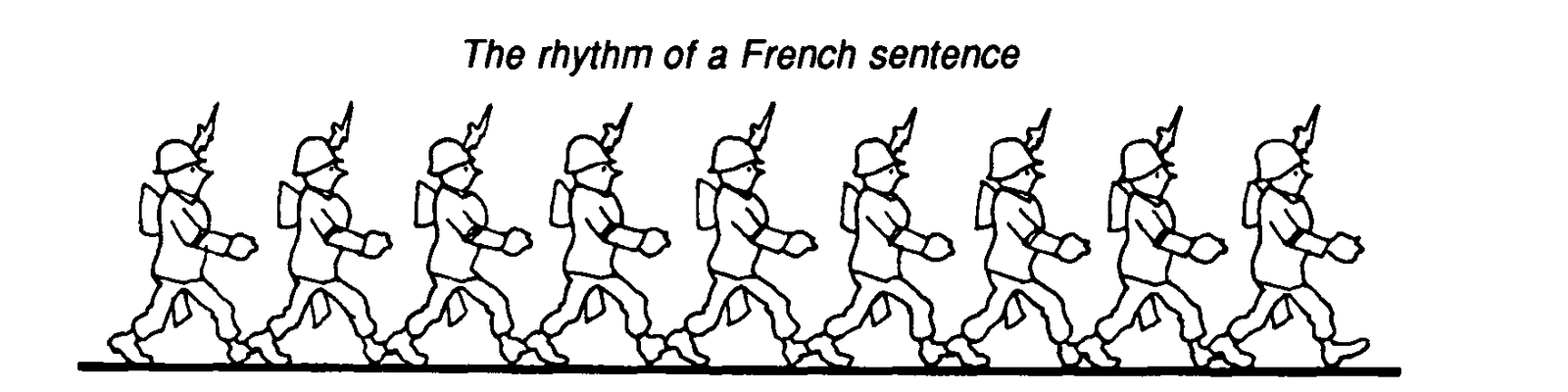
English is stress-timed: the stressed syllables fall at roughly even intervals, and everything else gets into the gaps between them, the way a family out walking stretches and —parents taking long strides, children to keep up.
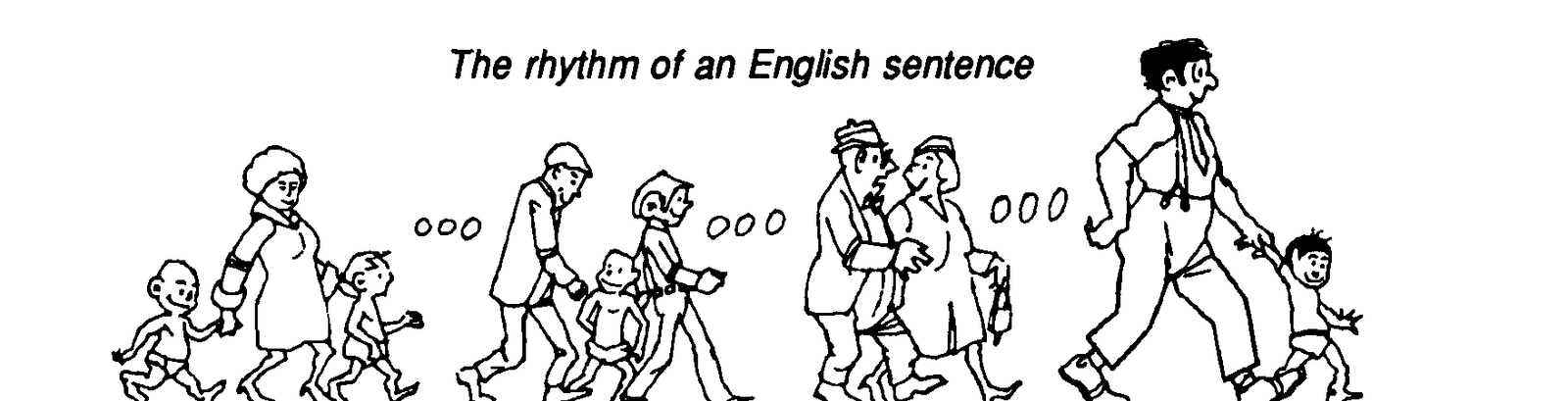
Carry the French, syllable-by-syllable rhythm into English, and it often comes out flat, because no word is clearly louder than the others. In other words, you speak English but sound French.
Spanish: Spanish is syllable-timed too, so Spanish speakers often bring their own speaking habits into English. What are these habits? In Spanish, the stress falls on the content words: nouns, verbs, adjectives and adverbs. In each case, a single syllable gets a little more push (stress). The function (linking) words, like articles and prepositions, usually get none. And every syllable takes about the same time to pronounce.
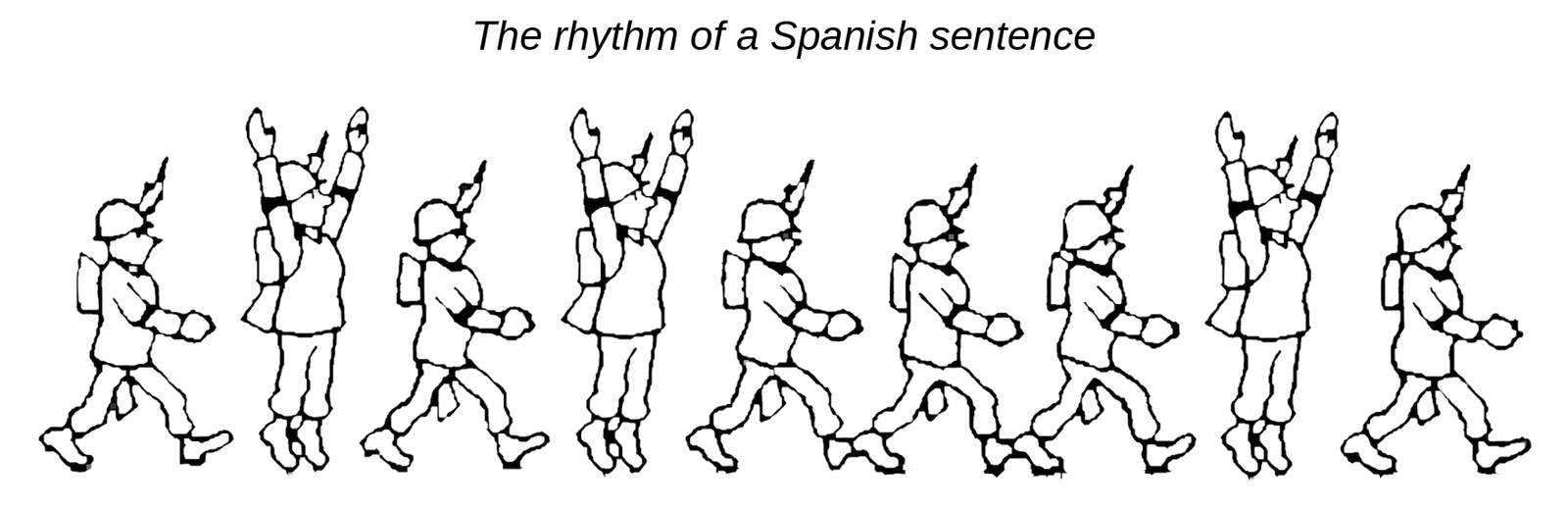
But English works differently. In English, the weak syllables get squeezed: they are shorter and softer, so the stressed ones can stand out. If you give every syllable the same time, as you do in Spanish, your English comes out too even, and your listener can't tell which words matter most. Fortunately, a 2025 study by Castrillo González offers some good news. In the study, 35 Spanish-speaking students took part in two rhythm training sessions. One group used hand movements to copy the English beat while reading out loud. Both groups improved, but the group using hand movements improved even more. This suggests that the answer is not just listening for the English beat—feeling it with your body helps the rhythm really stick.
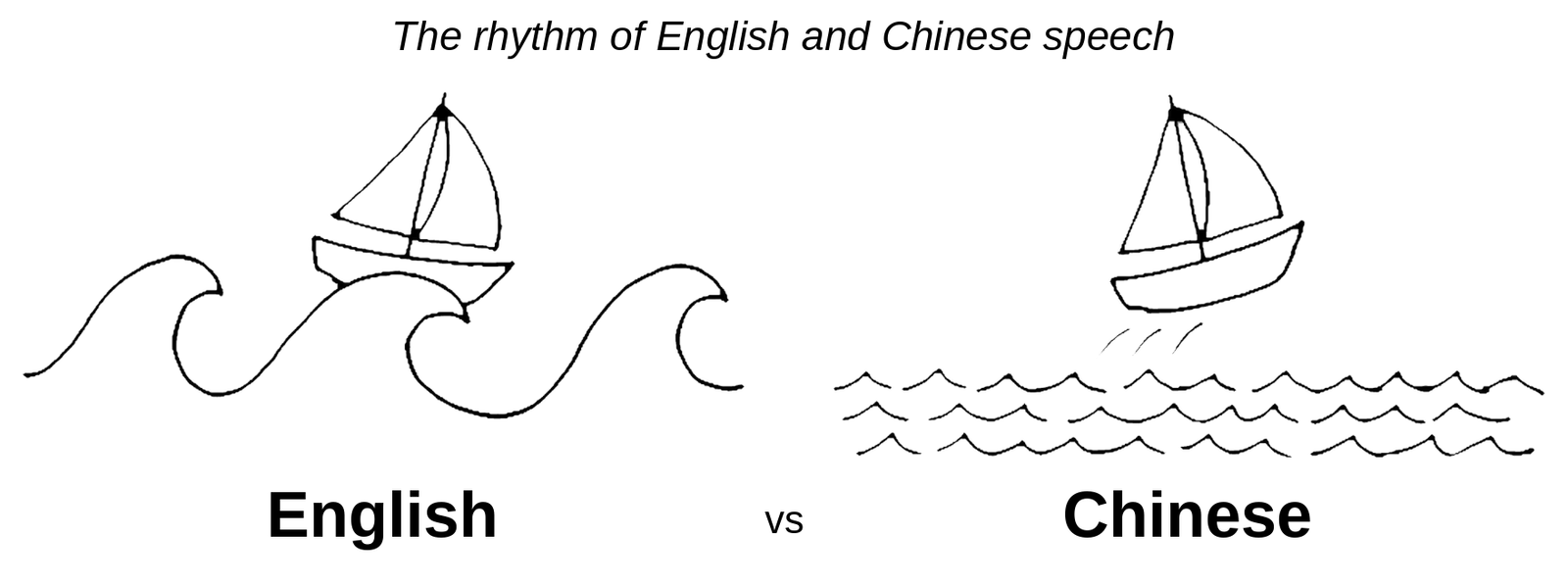
Chinese: If you speak Chinese, your first language creates a very different challenge. Mandarin is a tonal language. This means moving your voice up or down changes the meaning of a word, rather than making one syllable stronger than the rest. Because of this, Mandarin speakers usually do not lose the English beat. They shrink it. Chen, Robb, Gilbert, and Lerman (2001) found that Mandarin speakers still mark the stressed words, but not in exactly the same way as native speakers. A later study by Ding and Xu (2016) looked at Chinese students reading English aloud. Their English sounded closer to syllable-timed speech, partly because the vowels in the weak syllables were not reduced, so there was little difference between strong and weak. The beat is still there, but it is weaker. And because those weak syllables do not soften and blend into the background, your speech can end up sounding a bit , like a small boat bouncing over short, quick instead of riding smooth ocean waves.
Why Nobody Ever Taught You This
Teachers skip it. If you feel like you missed this lesson in school, you are not alone—many classes simply leave it out. In a survey of 163 English instructors in Saudi Arabia (Almusharraf, 2024), nearly 40% said they rarely or never teach rhythm, stress, or intonation at all. Teachers spend much of their class time on grammar rules and vocabulary lists, so the natural music of the language gets skipped. Later, their "untaught" students become professionals who will be asked—again and again—to repeat and repeat what they have just said.
Apps miss it. Language apps won't catch this mistake either. Pronunciation-scoring tools like Microsoft's Azure Speech are good at noticing awkward pauses or a flat, and voice, but they rarely notice if you put stress on the wrong word. So an app might tell you that you paused in a strange place, but it usually cannot tell you that you stressed "approve" instead of "that." And yet learners around the world spend billions of dollars on these apps every year. .
Even AI struggles. In a test called StressTest (Yosha et al., 2025), human listeners correctly heard sentence stress about 96% of the time. By comparison, GPT-4o's audio model got it right around 69%, and Google's Gemini 1.5 Pro managed around 78%. Live AI translation tools had an even harder time: in another study, the best system kept the speaker's stress only about 46% of the time (Chen et al., 2025). In short, teachers teach sentence stress, and even the smart machines built to understand human speech miss the beat. Learners are waiting to be taught, but the teachers and the apps are busy teaching other things.
The Fix
Listen first. The first step isn't speaking. It's listening— to notice the beat (sentence stress) before you ever try to produce it. Listen to a sentence and ask yourself: Which word got the punch? Do this often enough (and regularly) with real recordings—radio, YouTube videos, movies, TV series, interviews, or podcasts—and the pattern becomes easier to hear instead of staying invisible. Once you pull off its invisibility cape, sentence stress loses its power to keep you "stress-deaf." And the beauty of it is how transformational that simple awareness is. The more you hear, the more you hear. It is .
Build the sentence, keep the beat. When you are ready to practice out loud, try a simple, classic drill that still works well. You build a sentence up, a little at a time, while keeping a steady beat:
| Sentence Building |
|---|
| He NEEDS to SIGN. |
| He NEEDS to SIGN the DEAL. |
| He DOESN'T NEED to SIGN the DEAL. |
| He DOESN'T NEED to SIGN the DEAL this WEEK. |
The sentence gets longer, yet the rhythm stays steady—which is exactly how real English works. What matters most (content or primary words) . What matters less (function or secondary words) gets squeezed and makes room for what counts. Just .
Copy a cleaned up version of your own voice. For a very long time, learners were advised to choose a model and to record themselves repeating the sentence until they got it right. There is now a new option: recording yourself and then copying a "cleaned up" version of your own voice. Skarnitzl and Bořil (2024) found that practicing with a reshaped version of your own voice—rather than a native speaker's—can help learners improve their phrasing and melody. One possible reason is that it removes the pressure of trying to sound like someone else entirely. As famous British author Charles Dickens put it in 1853: "He appeared to enjoy beyond everything the sound of his own voice." . Just .
Conclusion
Word stress and sentence stress are really part of the same system, just working at two different levels—like two separate melodies flowing together in the same song. When you get the sentence beat right, it acts like a spotlight on a dark stage or a yellow highlighter on a page full of words. It shows your listener right away which ideas carry your main message, so they do not have to work hard to guess what matters most.
That simple signal makes a real difference. Hahn (2004) found that when a speaker stressed the right key word, listeners remembered more of what was said. They also rated the speaker more than when the exact same words were spoken with the beat in the wrong place. Put the stress on the wrong word, and it is like putting up the wrong street sign on a road: your listener gets , or , and walks away with a less positive impression of you, even though every single word and grammar rule was not only right, but exactly the same. Amazing, no?
And we have , back to the one line we started from: "We can't approve that budget." Say it flat, and the budget is dead. Hit "THAT," and your colleague knows exactly what you mean. One innocent little stressed word—a whole different message and result. You already have the right words. You worked hard for them. Now give them the right beat: listen for it, practice it, and put the punch where it matters most. Right words, right beat—that is the difference between repeating yourself and being heard.